For What It’s Worth
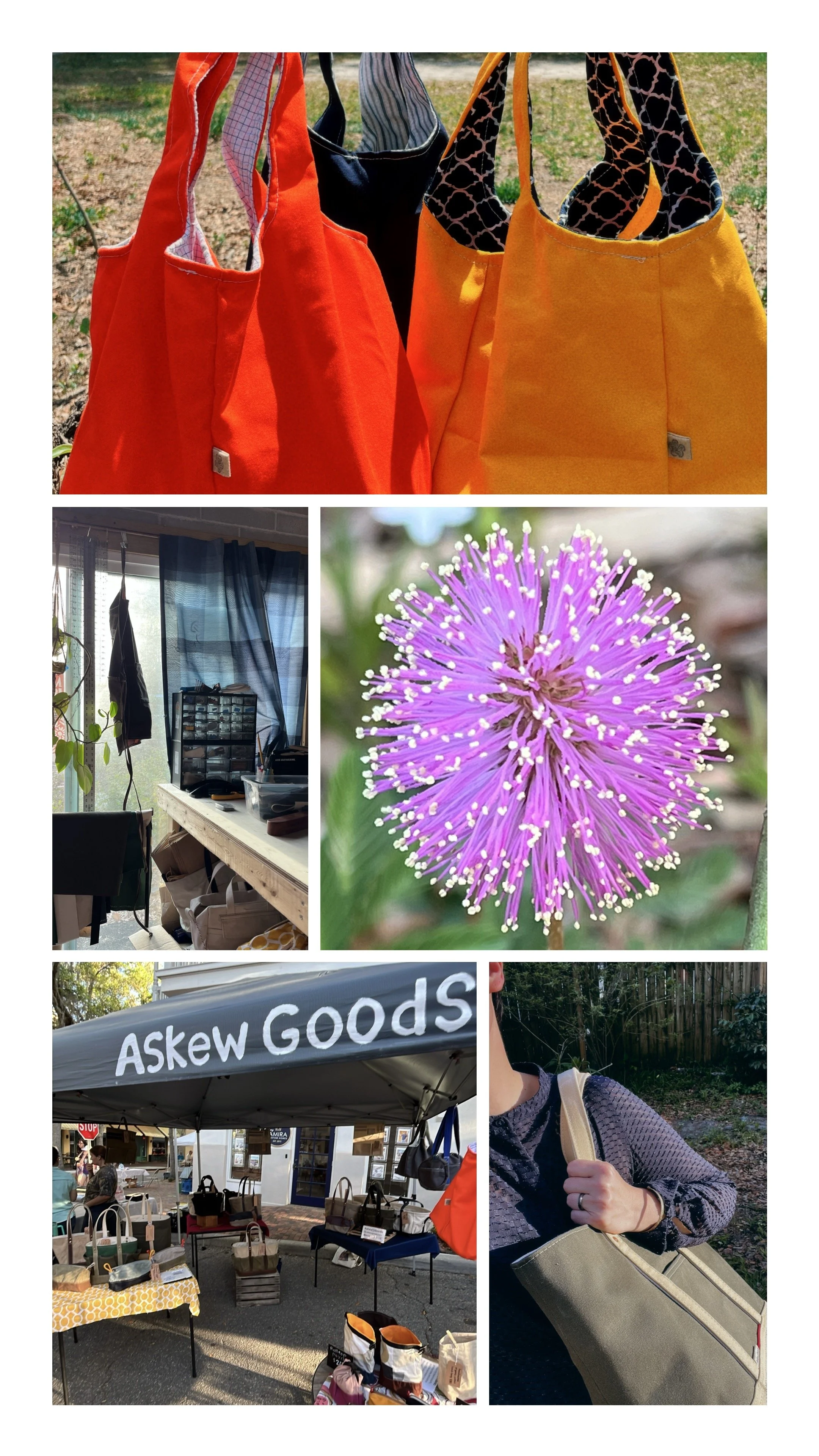
A collage of five images. Clockwise: yellow, orange, and navy grocery totes; sunshine mimosa; olive and khaki standard tote; our booth at Haile Plantation; the light in our studio.
On Saturday, we were invited out to Haile Plantation’s weekly farmers market to participate in their Spring festival.
It was a lovely morning and we received a lot of positive feedback and sent many bags off into the world. Near the end of the market though, a woman walked into the booth and went straight for the blue tote from the Drop Cloth series. She examined it and then said, “Price?”. I pointed to the large tag hanging from the strap that she was fondling. She saw the numbers and her mouth gaped open. She looked at me as if I had insulted her, threw up her hands, and walked away. Later, she walked past our booth again with her friends and I could tell she was sharing the story of the ridiculous price that we wanted for a tote bag. Yes, it was a handmade, one-of-a-kind tote bag, fully lined with plenty of pockets, an investment piece that comes with a lifetime repair guarantee. This was of no interest to her and honestly, that is her right. I didn’t take it personally. The reason I mention this moment is not because of the woman’s reaction but because of my reflexive reply: I apologized. It was a soft ‘sorry’ but I uttered it all the same.
This is something I regret because, you see, I am not sorry.
Since Caine and I started Askew almost a year ago, pricing our bags has been a challenge. In the beginning we did not want to include our labor in the cost since we were still learning our craft. We do select high-quality materials that are easy to factor into the price but then we often embellish them by dyeing or distressing the canvas (more labor as well as making them more unique). We have invested in equipment and given over large chunks of time to improve our skills. We have also had the poor luck of starting a business when the economy is in the ICU, especially with tariffs affecting our supply chains and shipping costs skyrocketing. These elements have influenced our prices but what has been more impactful is the shift in our perception of business and how it matches up with our ethos of sustainability.
Recently, we have more confidently embraced the value of slow-made goods created in small batches. We see that by stepping into the role of town bagmakers, we are also joining a long lineage of artisans who have made their livelihoods by pouring their energy and attention into the creation of goods.
Think of that word, goods. We included it in our name initially because we did not want to limit ourselves to bags but looking more closely at the idea of goods versus stuff, I am glad we had that foresight. We make durable goods that you can carry with you through life, knowing that your investment in each bag not only brings a bit of goodness into your daily adventures but also supports a new vision of consumerism. Yes, you can go to the nearby bigbox store and get a tote bag for a fraction of what we ask for but that purchase also reflects your values. Buying a cheap bag made from poor materials created in a factory far away with exploitive labor practices is not actually cheap. It comes at a great cost to our planet and humanity.
At the farmers’ market, I was thinking of how far consumers have come over the years. I remember when local farmers markets and organically-grown produce were new concepts. People would scoff at the prices farmers dared to charge for the goods they had grown from seed to harvest, or raised and rendered into dairy or meat. It was the same contest: good, nutrient rich food that supports a local economy versus sad mass-produced produce that destroys the land and water while bankrupting the farmers, exploiting the laborers, and only benefiting the agribusiness overlords. It is a battle that continues to this day but I feel like the local farmers are gaining ground in some places.
It is in great part a matter of undoing the lessons we have been taught: that quantity is better than quality. That we vote with our dollar so the more often we consume, the more we participate in our democracy. The reason those lessons were included in the curriculum was because the mainstream economy was built on unsustainable practices that require a constant influx of capital to hobble along. Many of us have been unschooled, in a way, and have begun to seek a new economy: one that recognizes that there are ecological limitations and includes values in its equations, including supporting local producers and small businesses as a means of building a thriving society that benefits all. This includes trusting that those who bake our bread and roast our coffee and grow our tomatoes are asking fair prices, based upon fair practices. Choosing quality as a form of deeper democracy, a means of creating a world of inclusion and respect.
So no, we are not apologizing for our prices.